Sunday, 7 February 2010

Warp core offline: proceed on emergency impulse power


Prepare to jettison warp engines and disengage by sublight evasion.

Another day, another adventure. Sunday beckoned, flouting her tempting charms at me, and off I went for a jaunt. Just a few miles, off to try and find the missus (farming, as she has a wont to do), then on to le supermarché pour la grub et les stúff.

There were a few big bumps in the road on the way, courtesy of emergency repairs to the winter potholes - which I'm sure the Cooncil intends to sort out properly later - but I didn't think anything of them. See as I cunningly build an alibi for myself for what is about to occur...

Exiting the car park and hitting a little hill, the bike suddenly faded and spluttered. Oh dear. This again - it happened on the Lang Way Roond trip as well, on the Lang Way Hame, due to the main jet needle being unsecured and riding way too high (mea culpa).

A quick haul onto the pavement, and the diagnosis began. The last thing I'd done before going out was to grab my trusty multitool(*), and damn glad I was to have it.

The plug was seriously fouled. Hmmm, that's familiar. I immediately suspected the needle again, but decided to clean the plug and lean the idle mixture out first to see if that sorted it. Nope, although I did get another 1/4 mile closer to home, nursing the bike along in gaps in the traffic.

At the next spluttering expiration, I parked up and unscrewed the throttle assembly on top of the carb to check the needle. Unfortunately, it was fine, properly secured under the clip and spring. Hmm, it did seem like a jetting problem, but not the needle this time. If the main jet was clogged, surely it would run lean, not rich?

Maybe the engine was just cooked? I gave it some time to cool down, with the plug out, cleaned everything up again, reset the idle mixture to 2 turns out, and had another go at getting home.

Bizarrely, the bike ran fine at idle and up to about 1/8th throttle, but on 1/4 throttle it just choked and faltered. I was quite impressed that it managed to get up to 30, nearly 40 downhill, on 1/8th throttle, and I managed to route through some industrial estates rather than holding up traffic on the big roads.

Eventually, I nursed it into my work car park, but with a big hill between me and home, Something Must Be Done. I was swithering between admitting defeat and calling my rescue service, or even shoving the bike into the work foyer overnight, but manned up and went for the carb strip. This is perfectly possible at roadside with pliers and a small Phillips bit, just take care not to lose any screw or nuts.

With it all apart, the cause was suddenly and glaringly obvious:


[Dramatisation]

Yup, the main jet had actually fallen off and was lying in the float bowl. That explained the behaviour fully - with no jet in the tube, as soon as the needle was raised, fuel was flooding up into the carb.

Huh, typical Chinese quality control! By which I mean that the stock 90 jet was fitted just fine, but some chump must not have tightened up the 95 jet that I - I mean, he or she - replaced it with.

Ah well, adventure over. With the jet secured properly, the bike immediately ran fine again.

The lesson here is that these bikes really are idiot proof, if the idiot can just stop mucking around with them.

So, no more fiddling, I promise. Well, I mean after I try the 100 and 105 jets again...


(*) Should Plod ever argues the toss with you about carring a multitool with a knife blade, please do remember this phrase: folding pocket knife with a cutting edge not exceeding 75mm/3", and I'll be having it back with an apology after I speak to the duty solicitor.

Thursday, 4 February 2010

And the performance is... is.... iiiiiiiis...


But first, some more ẁorship at the temple of LED.

The lower spots (£15 delivered!) came with a nice LED ring but 55W halogen foglight main bulbs. There was no way I was going to traumatise my poor little dynamo and battery by wiring in another 110W of load, but fortunately there are LED equivalents for the H3 type bulbs.

As you can see, they're tecno-tastic. It's like living in a bright bluish-white Futureworld. The moment there's a LED equivalent of the Xenon BA20D headlight bulb, I'll be on it like Angelina Jolie on an African orphanage.

But that's not why we're here, is it? It's to find out if de-catting the bike made any difference to the performance. Well, did it? Did it? Wait - why am I asking you? I'm the one who knows.

The glaciers withdrew briefly today, and I went for a lunchtime drag along the handy local dual carriageway. Up the on-ramp, feeling good, 30mph, 40, and an indicated 50 as I hit the main carriageway. Throttle pegged, here comes 55, and the 60-ish that's the usual top end. But wait - what's this? Do we see 65? We do! Do we see 70? Near as dammit, we do, in 5th and a fraction over 10,000 RPM. That's more like a real 65, but it's comfortably faster than the bike has ever shown on the flat, enough to keep up with the traffic and safely overtake Micra Man.

So we're clear, that's the purpose of getting that little bit of extra performance. It's not about burning rubber on the shopping trip, it's about the difference between holding up and keeping up with cars on open roads. Slower isn't safer if it means you're being tailgated by Astra Man.

For those keeping score, that's with a 17 tooth front sprocket, stock CDI, aftermarket coil and HT lead, a K&N stylee filter, 95 main jet and a DR8EIX plug (DR9EIX is a better for extended high RPM). Now that the engine can exhale, I'll re-try the 100 and 105 jets to see if the needle can go into the Forbidden Zone past 70.

So, was chopping the cats worth it? I'd say yes, but only because I did it on the cheap and enjoyed the process. If you had to pay for 2 aftermarket exhausts - assuming that you could find ones that were definitely cat-free - would it really be worth spending 1/5th or more of the price of the bike to get another 3 or 4 mph?

That's up to you to decide, gentle reader. I can only write my own tale. What's yours?

Sunday, 31 January 2010

Operation Convert Bike To Sparks: success!


Sacrifice to the Gods of Entropy and they may eat you last.

Things that I have learned:


  1. 1.5mm mild steel is arc weldable, but not necessarily by me.
  2. Sometimes, close enough isn't good enough.
  3. There's nothing you can damage with an arc welder that can't be fixed with an angle grinder, or vice versa.


My first attempt at welding in a section of pipe wasn't a total success. I used 38mm OD 1.5mm mild steel (35mm ID), which is at the lower end of what's arc weldable. Cut to the chase, I got it butchered together, but made a serious snafu: once it was all welded up, the exhaust plain didn't fit, no matter much much I swore, pleaded, or tried to negotiate with it.

I did a fair bit of offering up, then removing, tacking and re-offering but made one fatal error - I didn't tighten up the manifold nuts when offering the exhaust up. Consider that a few degrees of difference at the manifold means an inch or so at the tail joint. One I had it all welded solid, I could choose between a tight seal at the manifold and a clear 1" gap at the tail, or have the exhaust bolted on but spitting from the manifold.

In the event, I called a Mulligan, and decided to do it over. Since I'd burned through so much of the 1.5mm tube, I decided to go bigger. 2mm would likely be OK, but I wanted to be sure and went to 3.2mm, with an OD of 42.4mm = ID of 36mm. This was likely too big; an ID of 33 or 34mm would be a snugger fit, but you can always narrow wide pipe down.

First things first. This time, I'd be doing some serious welding with the exhaust on the bike, so the tank and battery had to be removed and buried 6' deep (well, balanced on top of the bins out the back, anyway):


Then I ground off the 1.5mm pipe section from the left hand pipe. As always, it took longer than I'd expected, and there must have been a small earthquake or similar, as I... uh... ground almost all the way through at one point. Mind Control Lasers, maybe.

Aaaaanyway. Remember the adage: welding can fix anything that an angle grinder messes up, and t'other way around too. A bit of 1.5mm patching over it covered up the evil. Let's never speak of it again.

I cut the the 3mm pipe to 1" longer than the removed section of cat-pipe. Another mistake I'd made the first time round was to make the replacement pipe too long. This meant that it went too far up the curve of the pipe on both ends, which contributed to screwing up the angles. See, I do learn, eventually.

Then each end of the pipe needed notches cut so that I could narrow it in. I'd recommend hacksawing these, rather than grinding them out, since the narrower they are, the easier it'll be to make them gas tight later:


Another lesson learned - this time I bolted the downpipe on solidly before even thinking about fitting the pipe. Note the car jack holding the lower section up at approximately the right height:


Then the ends of pipe section could be gradually narrowed down and offered up until it was fairly tight over both ends. I had to remove the whole assembly to bang it down tight. That's where your Anvil Shaped Object comes in handy. You do have an Anvil Shaped Object, right?

Once the new pipe was as tight as I could get it around the original exhaust, it all went back on again, and both ends of the exhaust were solidly attached. For those playing along at home: solidly attach both ends.

Then and only then did I weld up the joints. Rather than just tacking, I manned up and welded as much as I could manage in place. (Pro tip: remove the brake pedal on the right side to get more access to the bottom weld).

Only when I'd gone as far round the pipe as I could manage did I remove it. The unwelded parts of the pipe ends needed banging down again to get as tight a fit as possible. And the first thing I did then was to put it back on and check that it still fitted. See? Learning! See?

With everything seemingly OK, I removed the exhaust again and finally finished the welding. In my pre-emptive defence, it's a fiddly job, as you have to move the rod in 3 axes: rotate around the pipe, oscillate up and down to cover the joint, and move the rod in as it melts down. Very zen. Then there's the 8 notches in each end, 32 in all, that need sealed up. About 65 amps with a 2mm rod, for those taking notes.

Not the nicest welds in the world, but no, since you ask, I'm not planning on giving up my day job:


Fast forward, the 2nd exhaust went the same way, and a lot faster, since it was just a production line now. The bike fired up fine, this time with the exhausts seated properly. I found a few pinhole leaks, but they were quickly welded over, and some grinding neatened the welds up some:


...although they still need filing, filling and sanding before I paint over them, and I won't finalise that until I get a chance to take the bike out for a run. As usual for this winter, there's a localised Fimbulwinter on the stretch of road right outside my house. Hopefully my de-catted Penguin Murderatron will contribute to this alleged global warming which we could really do with round about now.

Speaking of which, here's one of the offending, offensive cats, the one that I didn't try and drill though:


You might think it wouldn't be hard to drill right through that. Well, think it all you like. It's harder than a scrap-yard dog with a flick knife.

Well, that's us 90% done. If I was doing it again, I'd try and get some 33 or 34mm ID 2mm pipe. Also, I wouldn't do it at all.

But since it's done, all that remains is a road test to see if I've helped, harmed or not done a damn thing to the performance. Nobody laugh; it could have helped it breathe. You'll see. You'll all see.

Sunday, 17 January 2010

Catalytic cutting catastrophe

But first, Previously On Bike-in-a-box-blog.

Measure twice, cut once, goes the mantra. Well, in an uncharacteristic display of common sense, I only drilled once before measuring the choke assembly.


The small metal widget in the top right is the actual choke actuator, which rotates to operate the choke inside the carb. Note the shiny new hole drilled in it, where I was going to attach a choke cable. Note also that with the plastic choke lever down (i.e. choke off), the actuator is raised. Annoyingly, it's sprung so that without being held up there in the off position, it would spring down and turn the choke being fully on. This is pretty shoddy design to begin with - if the choke assembly fails for any reason, the choke will come on full. Not good. Note that this is on a Japanese Mikuni carb emulating the behaviour of the Japanese designed CG125: I don't think a Chinese design would be as fail-fragile.

The show stopper is that the actuator needs to be pulled up in order to turn the choke off. However, all sane choke knobs are pulled up to turn the choke on. I'd have to reverse the direction, which could be done by attaching the cable to the plastic choke lever instead. However, the lever isn't sprung, and would require the choke cable to not only pull it up, but to positively push it back down again, which wasn't going to happen.

I tried fettling it various ways but couldn't find an arrangement that would operate the actuator correctly and reliably (i.e. stop the choke from springing on), so I declared it a draw and shelved the idea.

Decatalysing, Round One

Guru Forchetto from defunct TheChineseBikeForum always held that the cheap basic catalytic converters fitted to our bikes were one of the primary causes of the drop in torque and power from their original configuration. Arguments about exhaust baffles and back pressure and two exhausts versus one aside, it's undeniable that these engines were not designed with cats in mind, so it's worth a try. The polar bears can just deal with it. What have they done for me lately?

So I've had a plan for some time to de-cat my bike, and this weekend saw it swing, saw and weld into action. This may turn out to be a mini series in its own right.

First, where and how to cut? From doing a bit of wikiing I'd hoped that the cat would be a relatively fragile ceramic, that I'd be able to drill, chisel or just smash to pieces by going in at one end.

So I decided to make a straight cut just under the cat bulge. First, I drew a couple of lines across the cut so that I could match up the orientation again later - this turned out to be pointless because the amount of handling required quickly erased them, but not a disaster as it's easy enough to offer the pieces back up again and re-mark them prior to welding.

A hacksaw went through quite easily, and I was pleased to find that the mild steel is a good 2mm thick, and thus OK to arc-weld back together again.

It turns out that inside the pipe there's an inner pipe of slightly smaller diameter. I'm not sure what the purpose of this is; probably some sort of circulatory magic gubbins. In the event, I inadvertently lopped off an inch or so of it, which I just discarded rather than trying to weld it back on.

This exposed the end of the cat bulge and the cat lurking inside. It starts 3/4" or so inside the bulge, and looks like... well, I'll take a picture first next time. It's a honeycomb structure that looks to be stainless steel, but very fragile, so in I went with a 20mm wood-hole cutting drill bit, expecting it to shred fairly easily.

Hmm. Er. Mmmm. Nope.

The honeycomb immediately flattened and toughened up and the bit was just polishing it. OK, switch to an 8mm HSS metal bit. That went in 1" or so, and that's all she wrote. I drilled a few such holes, but they weren't anywhere near close to going right through the cat. Pressing hard resulted in another 1/8" penetration and a glowing red bit tip. Oh my.

Next up was a curved chisel, which I whacked into the cat around the edges to see if I could detach it from the pipe walls and just pull it out. It went in 2" or so, and I managed to deform the cat a fair bit and pull some small lumps out with pliers before the chisel, well, snapped clean off while I was wiggling it around.

OK, rethink. If I couldn't get it out from the end, what if I cut the cat bulge in half in the middle? I might be able to chisel the half-cat out from either end and pull them out. So in with the hacksaw, which went through the pipe wall, hit the cat and... that's all she wrote (again). I just couldn't get through it.

After some more bashing, whacking, stabbing and hammering, I had to acknowledge that all I was doing was choking up the cat, and called it a night before I made things worse. These things are tough:


Note the snapped off chisel at the bottom!

That left me with a butchered cat, and a half-cut pipe. I wanted to get the bike back the road, so decided to just weld it all back up, and source some pipe to replace the whole cat bulge with, rather than trying to remove the cat and retain the pipe.

My welding is... well, weld is as weld does. If it holds, it's a good 'un.


Not the best weld in the world, but it's been a while since I did one. That's using a 1.6mm rod and about 50 amps; I didn't want to blow right through the steel. Actually though, I reckon it could stand a 2mm rod and 60+ amps, which I'll use when I replace the pipe.

Getting the main weld right was a bit of a fuss. Putting the pieces back on the bike and marking the join was simple enough, but I'd cut too close to the bulge, and hadn't enough straight pipe on the cat side to get a clamp on the pieces. In the event, I had to hold the pieces together while tacking them, sans face shield, and just wearing clear goggles to protect from weld splatter.


I got it eventually though, and butchered my way around the join, brushing and grinding it down and going around a few times to try and get it solid - I should have switched to 2mm sticks, really.

Well, good enough. It'll only have to hold until I get the pipe.


I'm not even going to paint over it, since I'll just be cutting and re-doing it soon anyway.

Despite the choked up cat, the bike started and ran fine. The weld is gas tight, and the exhaust didn't drop off, so job done.

I'll get some pipe with an ID that matches the OD of the main pipe, so that I can sleeve it over it (much like the cat bulge) rather than trying to weld a piece inline; that's unnecessarily tricky. Having it sleeved will also make it easier to keep it together while I tack it and offer it up.

Well, not a success, but not a disaster either, and I did achieve my real objective: Welding Stuff.

Welding Stuff is all that separates us from the animals. That, and blogging.

Thursday, 10 December 2009

Bend like the reed, don't break like the oak.

In other words - I give up. The hot rubber smell is still present, but I can't determine a cause. The bike is running absolutely fine, with no hint of clutch slip, and I can't think of any other cause.

So we'll shove it on the To Do list, along with the stripped sump threads, for the first engine rebuild. While we're making that list, the exhaust is smelling slightly oily, so a piston ring replacement followed by a Mototune break-in is on there as well. I'm quite taken with the idea of a hard initial run-in to seal piston rings, and am regretting running my bike in so gently.

All that said, it is running great - I'm really just looking for excuses to strip the engine.

While I await the joyous day, it's back to more fiddling with lights.


The speedo bulb developed an intermittent fault which steadily got worse until it gave up altogether. Obviously, my legal team leapt into action and served a writ of habeus judice under the Statutory European Human Consumer Rights Act, demanding a replacement of the entire bike, £50,000 in inconvenience and legal costs, and a hundred beelyon dollars in punitive damages.

While I wait for that to play out in Brussels, I popped the speedo unit out for a look. There are two nuts underneath that hold the unit together. With them removed, the top lifts out - itself a sealed unit - exposing the light bulb at the back. Some fiddling revealed that it was just a loose fit between the bulb and the holder, just a casualty of vibration. But since I had it off, I went all LED, all the way. The princely sum of £6 secured 6 x T10 501 round top LED bulbs, which are now fitted to the speedo, tacho, indicator, neutral and full beam lights.


They're a definite improvement in the centre console; the overall light output is probably similar to the 2W incandescents that they replace, but it's much more directional, which is ideal for these mounts. In the dial consoles, the advantage isn't so clear. The top of the dials are better illuminated, but the bottoms less so. Still, the important speeds are at the top, so I'm OK with that.

So I'd recommend replacing the incandescents with LEDs, but would suggest using larger wide-angle caps for the dial controls.

Next on the project list is fitting a choke cable. The choke is mounted directly on the carb, and it's fiddly reaching under there to flip it, especially in the dark, with thick gloves on - i.e. in winter, when you actually need it.

So I've bought a universal choke cable, sold for use on Minis.


I reckon it should be possible to finagle this onto the bike somehow to remote operate the existing lever, although it'll need shortening, and mounting brackets fabbed up. Mmm, fabbed. Let's all say it together; faaaaabbed.

Saturday, 14 November 2009

Listen... you smell something?


Some exaggeration for effect may be in evidence.

Where I been at, I hear you ask? I been at one with my bike, just tripping and... uh... gripping and... such-like. I think in the near future, we can only expect updates when things go awry.

Up until this week, things have been non-awry. I haven't managed any more mini-epics, just commutes and pleasure jaunts. The bike has been behaving itself just fine, although the tyres are not great in the wet, and roundabouts need to be treated with serious respect - I've had a foot down to correct a wobble. Woke the cagers up, anyway.

However, this week has brought a potential new issue, a mild cooking smell. It's a 'hot' smell rather than sharp burning, is evident even after short runs, and it smells vaguely rubbery. There's nothing binding on the wheels, and I can't find anything touching the engine, although it does seem to be coming from down there. So, internal then.

I suspect the clutch, particularly with the switch to fully synthetic oil and the Activ8 treatment that I did a while back, but if it's that, then it's taken a long time to start slipping. I've adjusted it up, and there's no feel or sound of slipping evident.

Well, first port of call was another oil change today, still with 5W-40 synthetic, but the smell still seems to be evident. Then it stalled entering a roundabout, just faltered, popped and died. OK, I was being a bit limp-wristed, and it started right up again, but we're not having that.

The other thing that occurs then is the valve clearances. I've had them tighten up to nothing once before, as did SteveF on the Chinese Bike Forum, and they are suspiciously quiet at the moment. First thing tomorrow, it'll be off with the rocker cover and out with the feeler gauges. Then we shall see what we shall see. Oh yes, we shall. See, I mean.

Thursday, 10 September 2009

Intensify forward lightpower!


I don't want anything getting through...

...'specially geezers in Kias.

Well, what do you expect? The bike's running like a dream, so I was left with no choice but to add some more bits. No choice, I tell you.

The two new lights are the ones below the headlight. They're fitted to a bar that's bolted on to the mounts that were used by the stock "Huoniao" badge, and were a steal at just £15 for the pair including delivery. There's a LED light-ring round the edge, and 55W 'halogen' (apparently) bulbs. I've only wired up the LEDs just now, since I'm already running a 55W headlight, and 175W or so total in lights would be asking way too much from the plucky little generator and battery. I may wire the 'halogens' up to the full beam switch as brief "flasher" lights for saying "hello" to other bikers - or "HERE I AM!" to cagers, for that matter. The more presence, the better.

In servicing news, I did another oil change at 2880Km or so. I think it's the 6th change in total. I've been getting some clutch drag with Halfords 10W-40 semi synthetic motorcycle oil, so went for their 5W-40 fully synthetic. Verdict: yes. It's subjective, but the bike feels a little quieter and smoother, and the clutch drag is definitely decreased. With the 10W-40 semi, when the engine was hot, I had to kick up from 1st to 2nd and then back down to get neutral, but now I can go from 1st to neutral more easily.

The cut-down DPR8EA-9 plug was working just fine, but I got the eBay itch and grabbed a DR8EIX (I had a DPR9EIX-9 in for the Lang Way Roond). The starting and warming up with the iridium plug is great, and in conjunction with the 5W-40, the low speed running is really steady, with no hint of hesitation or roughness, and less clutch grab. We're only talking about a marginal improvement, but it all helps with confidence at low speed. Which as we all know - or will find out eventually - is where you're most likely to drop the bike.

Speaking of which, a work chumrade (not the Lang Way Roondie) has just bought a spanking new Suzuki Bandit GSF650S. Lovely bike, absolutely lovely. And heavy. Really heavy. And I've got these short Scotch legs and... well... I dropped it in the work car park. With 90 miles on it.

I'm going to hell.

On the bright side, the bits to fix the right side (indicator, brake lever, mirror) were surprisingly cheap, and hey, now I own part of a Big Boy Bike. Plus as a salve to my conscience, he then dropped it at some lights, on the left side, so at least it's nicely symmetrical again.

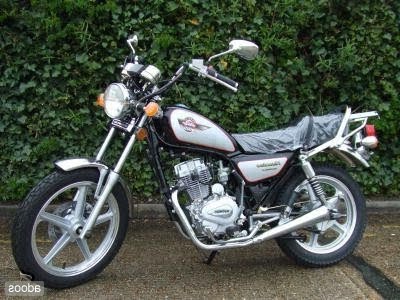
Unfortunately, I really do think I'm reaching the end of what I can do with the Huonaio[*], short of grinding and welding, so it may be time to start thinking about sitting a test. Not necessarily so that I can get a bigger bike, but it's an easy piston swap to a 150cc, or we could give it large to 200 or 233cc.

You gotta have a dream, don't you?

[*] davidqc over at the Chinese Bike Forum turned up the trouser-stiffening info that Huoniao means Firebird. Hmm... Firebird HN125-8. Sounds much studlier.